🔏 Safe and Secure Checkout | 🔄 Easy Returns within 30 days | 📜 Free 1 Year Warranty on all Refurbished Gaming Consoles | 👮🏿 💒 Service Member, Government Worker, EMS & Teacher Discount Up To 20%👩⚕️ 🏥 | 📦🏷️✈️ Free U.S Shipping on Orders over $50 - DAILY WORLDWIDE SHIPPING 📦🏷️✈️
The short answer: a properly refurbished console gives you 90% of the original experience at a fraction of the risk. An untested original is a gamble. A professionally refurbished unit is a known quantity.
But "refurbished" has become nearly meaningless.
Quick Comparison: What You Get With Each Option
A refurbished console is a pre-owned system that has been inspected, cleaned, repaired where needed, and tested for full function before resale. An original console is a vintage unit sold as-is, often untested, with no warranty and no guarantee it will survive shipping.
Factor
Refurbished Console
Untested Original
Upfront price
Higher ($130-$190 typical)
Lower, but variable
Failure risk on arrival
Low, tested before shipping
High, unknown condition
Warranty coverage
Often included (90 days to 1 year)
None
Cleaning and inspection
Done before sale
Buyer's responsibility
Resale value
Stable, documented condition
Depends on hidden faults
Best for
Players who want to actually play
Collectors who enjoy restoration
How to Verify Refurbished Console Quality Before You Buy
Verification starts before you spend a dollar, but it does not end with a seller's word. The gap between a real refurbishment and a cosmetic resale is visible if you know where to look.
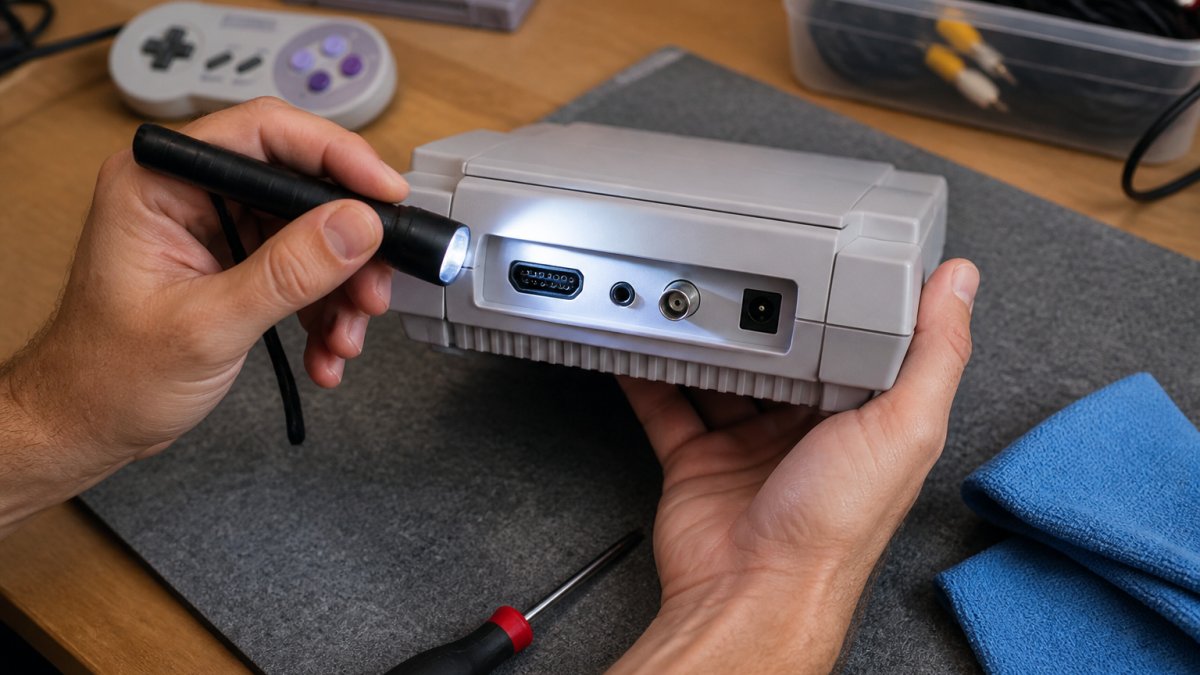
Person using a flashlight to inspect the ports of a vintage game console on a workbench with cleaning tools
A legitimate refurbishment includes opening the shell, inspecting the motherboard for corrosion or bulging capacitors, cleaning the cartridge slot or disc drive, and running the system through actual gameplay before it ships.
The Technical Verification Checklist
Use this checklist when evaluating any refurbished console, whether you are buying online or in person:
Motherboard inspection: Ask whether the board was checked for capacitor leakage, corrosion, and prior repair work.
Video output test: Confirm the console produces a clean signal on original hardware, not just that it powers on.
Disc drive or cartridge slot: For disc-based systems, ask about laser condition and read reliability. For cartridge systems, ask about pin cleaning.
Controller ports: All ports should be tested with a known-working controller.
Power supply: Confirm the included power supply is correct for the model and tested for stable output.
Cosmetic condition: Ask for photos of the actual unit, including the underside and rear ports.
Warranty terms: Get the coverage length and what it includes in writing.
Component-Level Verification: What to Actually Look For
1. Capacitors. Electrolytic capacitors are the most common failure point in retro hardware, especially pre-mid-1990s systems.
2. Motherboard stamps and revision codes. Every major retro console shipped in multiple board revisions, some more reliable than others.
**3.
**4.
5. Connector wear. Check the cartridge slot pins, controller port pins, and power jack.
6. Serial number and region consistency. The shell's serial number should match the region and revision of the board inside.
Watch OutA "refurbished" label with no warranty is a resale, not a refurbishment. If a seller will not put their coverage terms in writing, or will not send a photo of the actual board, assume the unit was never opened.
Remote Buying: How to Verify Without Holding the Console
Most buyers shop online, so verification becomes a documentation exercise. Ask for:
A photo of the open shell with the board visible, dated and showing the seller's hand or a card with today's date.
A short video of the console booting a known-demanding game, for example, a disc-based system reading a dual-layer disc, or a cartridge system running a game with heavy sprite work.
The board revision code photographed in focus.
A written statement of what was replaced, cleaned, or left original.
Pro TipIf you are buying in person, bring a known-good game, a known-good controller, and a small flashlight. Boot the console, play for at least ten minutes, and check the underside and rear ports before you pay. Ten minutes of testing prevents most of the returns that plague disc-based retro systems.
Retro Gaming Console Warranty Importance: What Actually Matters
Warranty importance comes down to one question: who pays when the console fails? Vintage electronics carry real failure risk, and a warranty is the only thing standing between you and a paperweight.
A 90-day warranty covers the initial failure window, when most defects surface. A 1-year warranty covers the longer tail, including slow degradation that hits aging power supplies and disc drives months after purchase. For a system you plan to keep, the longer coverage is worth paying for.
Pro TipAsk what the warranty actually covers before you buy. "Functional guarantee" and "parts and labor" are very different promises. The first means they will replace a dead unit. The second means they will fix the specific fault.
Disc-based systems fail in ways that only show up after hours of play.
The Best Classic Gaming Console for a Dorm Room
The best classic gaming console for a dorm room survives being shoved in a backpack, runs on a standard TV or monitor, and does not need a shelf of accessories. For most students, that means a cartridge-based system with a durable shell and a huge library of cheap games.
Our pick for dorm life is the Super Nintendo System at $189.00. It ships with the power cord, A/V cable, and one or two SNES controllers, and every refurbished unit includes a 1-year warranty.
If you want more variety, the Sega Genesis Model 1 Console at $166.00 covers a different library and comes with a 90-day warranty. For a modern-style controller and GameCube compatibility in one package, the White Nintendo Wii Ultimate Hunting and Driving Bundle at $159.99 is the most complete setup we carry, with two Wii Remotes, two Nunchucks, two Zappers, a Wii Wheel, and three boxed games.
Sega Genesis Model 1 Console - Sega Genesis (Refurbished)
White Nintendo Wii Ultimate Hunting and Driving Bundle (GameCube Compatible)
Best ForStudents who want a plug-and-play system that survives a dorm room and does not need a CRT television to work.
Total Cost of Ownership: Refurbished vs Original vs Repair
Total cost of ownership is where the "cheaper" original often stops being cheaper. Add repairs, replacement parts, shipping both ways, and your own time, and the math shifts.
Path
Upfront Cost
Likely Repairs
Warranty
12-Month Real Cost
Refurbished (warranty included)
$130-$190
Covered
Yes
Upfront price only
Untested original
$60-$120
$40-$150+
No
Upfront + repairs + shipping
Self-repair of broken unit
$30-$80
Parts + your time
No
Upfront + parts + labor
The PlayStation (Original & Refurbished) at $130.99 is a good example. It arrives with the AC adapter, A/V adapter, and one controller, fully reconditioned and tested.
The one scenario where self-repair wins: you already own soldering tools, you enjoy the restoration process, and you are buying a broken unit specifically as a project.
Modding vs Refurbishing: Which Path Fits Your Goals
Modding and refurbishing solve different problems. Refurbishing restores a console to reliable original function; modding changes what it can do, often adding modern video output, region-free playback, or storage upgrades. A refurbished console is the better starting point for either path.
Most buyer confusion comes from sellers using the two words interchangeably. A listing that says "refurbished with HDMI mod" describes two separate services with two separate risk profiles.
What Refurbishing Actually Covers
A proper refurbishment is restorative, not transformative. It returns the console to the condition it was designed to be in:
Replacing failed or out-of-spec capacitors
Cleaning and re-tensioning cartridge slot pins or servicing the disc drive laser
Replacing thermal pads or paste where the original has dried out
Cleaning the shell, buttons, and controller ports
Testing every function against known-good games and accessories
The output is a console that behaves like a well-kept original. Nothing about the experience changes, it just works reliably.
What Modding Actually Changes
Mods fall into a few broad categories, each with different trade-offs:
Video output mods. RGB, component, or HDMI mods bypass the original video encoder for a cleaner signal on modern displays. Popular on NES, SNES, N64, Genesis, and PlayStation. Trade-off: requires soldering to the video encoder pins or digital video bus, and a poor install can introduce jailbars, audio hum, or signal loss.
Region and lockout mods. Region switches, modchips, or BIOS replacements let a console play imports or backups.
Storage and optical drive replacements. Optical drive emulators (ODEs) replace a failing disc drive with an SD card or USB solution.
Screen and shell mods. IPS screen replacements on handhelds, or custom shells on home consoles. Trade-off: cosmetic and ergonomic, but non-original shells lower collector value.
Recap and power mods. Modern power supply replacements or full recaps.
How Mods Interact With Warranty and Resale
If you buy a refurbished console with a warranty and then mod it, you have almost certainly voided that warranty. Most refurbishers will not cover a unit opened and soldered on by a third party.
Resale value moves the opposite direction. An unmodded, professionally refurbished console appeals to the widest buyer pool, collectors, players, and resellers. A modded console appeals to a narrower group, and a poorly executed mod can drop the value below an unmodded unit.
Key TakeawayRefurbish first, mod second, and only after the warranty window closes if you care about coverage. A mod on a failing console just gives you a failing console with extra features.
Matching the Path to Your Goal
You want to play original cartridges and discs on original hardware. Refurbishing alone is enough. Skip the mods.
You want modern video output on a flat-screen. A video output mod makes sense, but only after the console is confirmed working. Budget for a professional install; a bad HDMI mod is worse than composite on a CRT.
You want a collectors' piece that retains resale value. Keep it unmodded. Modifications narrow the buyer pool and can lower resale value.
You want maximum longevity from a disc-based system. An ODE is the most durable path, but accept that you are giving up original disc playback.
You want a project. Buy broken, refurbish yourself, then mod.
The Commodore SX-64 Executive Computer Video Game System at $909.99 is a good example of a system where modding rarely makes sense. It is a piece of computing history with a built-in CRT, a 5.25-inch floppy drive, and 64KB of RAM. Keep it original.
Commodore SX-64 Executive Computer Video Game System
Sustainability and the Future of Retro Gaming
Sustainability is the quiet argument for refurbished hardware, and it is getting louder. The 2026 market data backs this up: the retro console market grew from $3.8 billion in 2025 to a projected $4.18 billion in 2026, according to Quantumrun's retro gaming console sales statistics.
Physical media faces its own preservation challenge. The same Retrolize industry analysis notes that discs degrade over time from scratches, disc rot, and long-term storage damage.
For buyers, the takeaway is simple: refurbishment is the sustainable path and the reliable one. You get a tested system, a warranty, and hardware given a second life.
The challenge with retro gaming is not finding a console. It is finding one that actually works when it arrives and keeps working six months later.
Frequently Asked Questions
Is it worth buying a refurbished game console?
For most buyers, yes. Refurbished retro consoles cost less than original units in good condition and come with professional testing, cleaning, and often a warranty. A refurbished unit from a reputable seller gives you working hardware without the risk of a dusty garage-sale gamble.
How can you tell if a refurbished console is high quality?
Ask the seller what the refurbishment process includes. A quality refurbisher will test all controller ports, check the power supply and video output, clean the motherboard, and replace capacitors if needed. Look for specific language like 'tested and cleaned' rather than vague claims. Request photos of the actual unit and check that the warranty covers internal components, not just cosmetic issues.
Do refurbished retro consoles come with warranties?
Many do, but coverage varies. A 1-year warranty on a refurbished console is a strong signal that the seller stands behind their work. For example, the Super Nintendo System from Retro Gaming of Denver includes a 1-year warranty. The Sega Genesis Model 1 Console comes with a 90-day warranty. Always read the fine print to see what is covered and how to file a claim.
Original vs refurbished: Which lasts longer?
A professionally refurbished console often lasts longer than an untested original because worn parts like capacitors and disc drives get replaced or serviced. An original console that has never been opened may still have 30-year-old components ready to fail. The key is the quality of the refurbishment, not the label. Look for sellers who test performance and offer a warranty.




Leave a comment